Smart Cat Collar & Feeding Systems
A connected cat-care product line for a client. A wearable smart collar with activity tracking and location-context beacons, plus a wet-food feeder family anchored by a compressor-based sub-zero hopper for week-long safe storage. Prototyped through bench and on-cat testing.
A client engaged Groundplane to design a connected cat-care product line: a wearable smart collar and a family of feeders. The collar would track activity, location-context, and biometrics in a form factor a cat would actually wear. The feeders would address the central problem with automated wet-food serving: wet food spoils fast. The program ran through initial prototype builds, bench testing, and on-cat data collection.
The collar
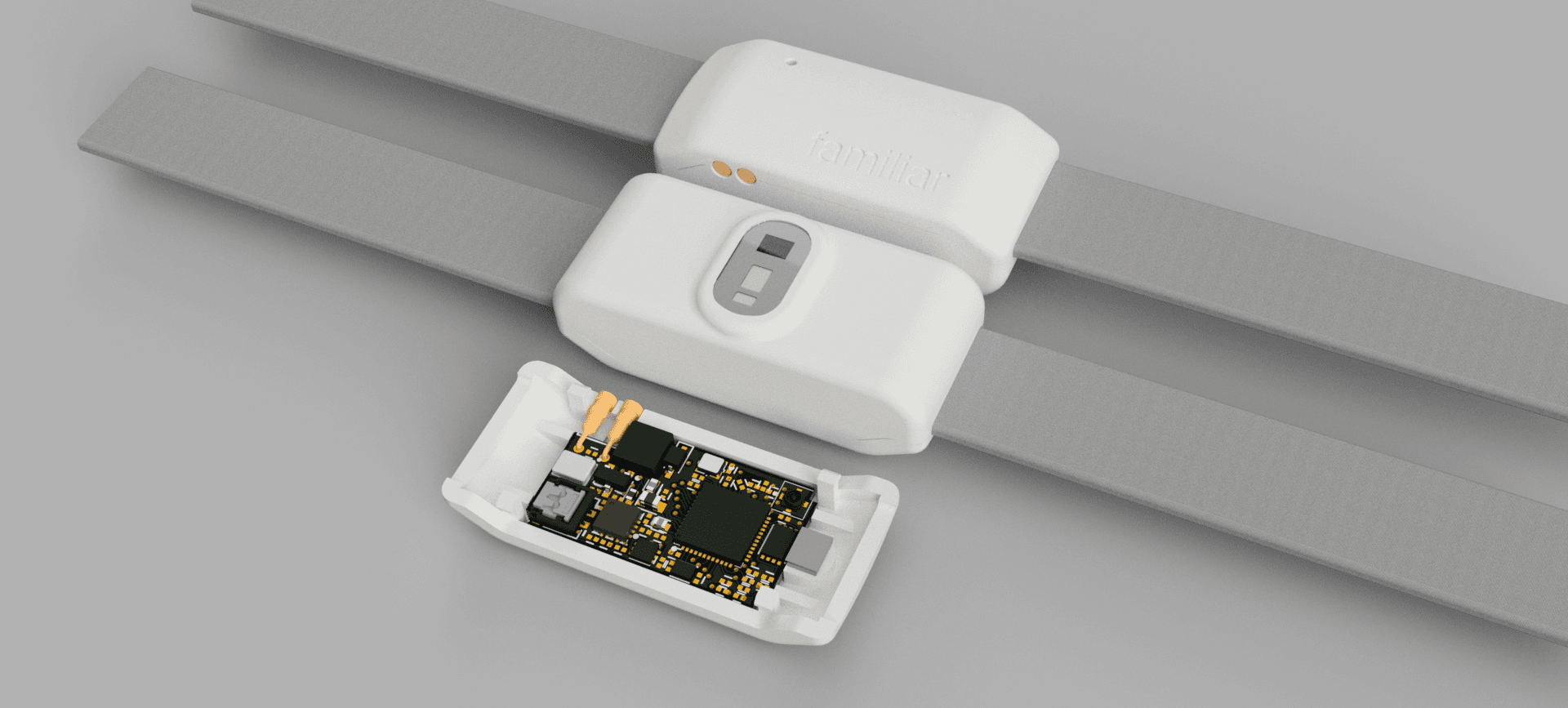
The collar lived on a 14 by 30 mm board, sized so a cat would actually wear it. An nRF52-series SoC sat at the center for ultra-low battery draw. A 9-axis sensor (accelerometer, gyroscope, magnetometer) read motion and orientation to classify activity throughout the day. Tracking beacons placed near common stations (food, water, litter) gave the activity classifier the context it needed to label what the cat was actually doing. A microphone captured audio for later interpretation. A buzzer and LED helped owners locate a cat that had wandered off. Heart rate, SpO2, and skin-temperature sensors were on the board for biometric tracking, though early on-cat trials did not yet produce clinically useful signal.
- 14 by 30 mm board, sized to be worn by a cat
- nRF52-series SoC for ultra-low battery consumption
- 9-axis sensor (accelerometer, gyroscope, magnetometer) for activity classification
- Tracking beacons at common stations (food, water, litter) for activity context
- Onboard microphone for cat audio capture
- Heart rate, SpO2, and skin-temperature sensors for biometric tracking (early data quality limited)
- Buzzer and LED to help locate the cat
The feeders
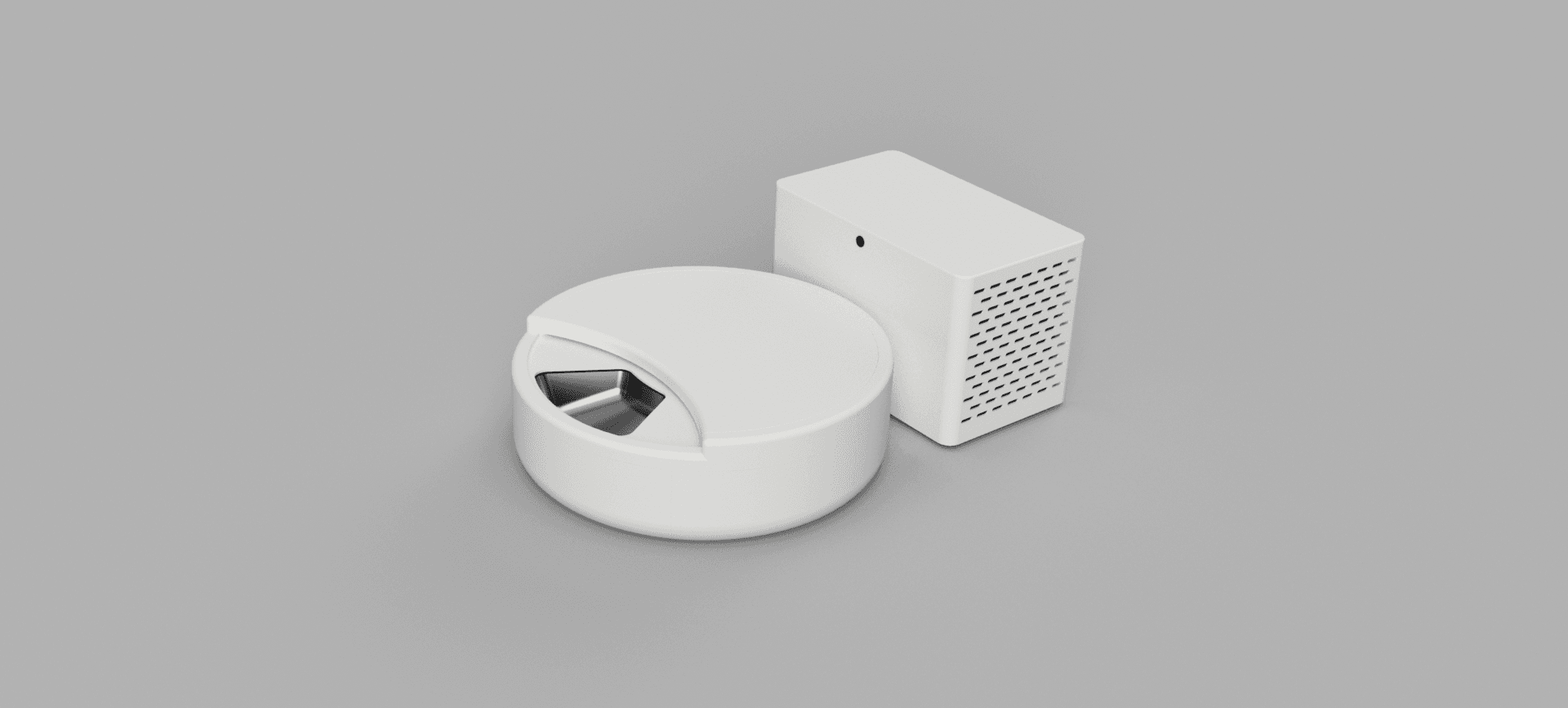
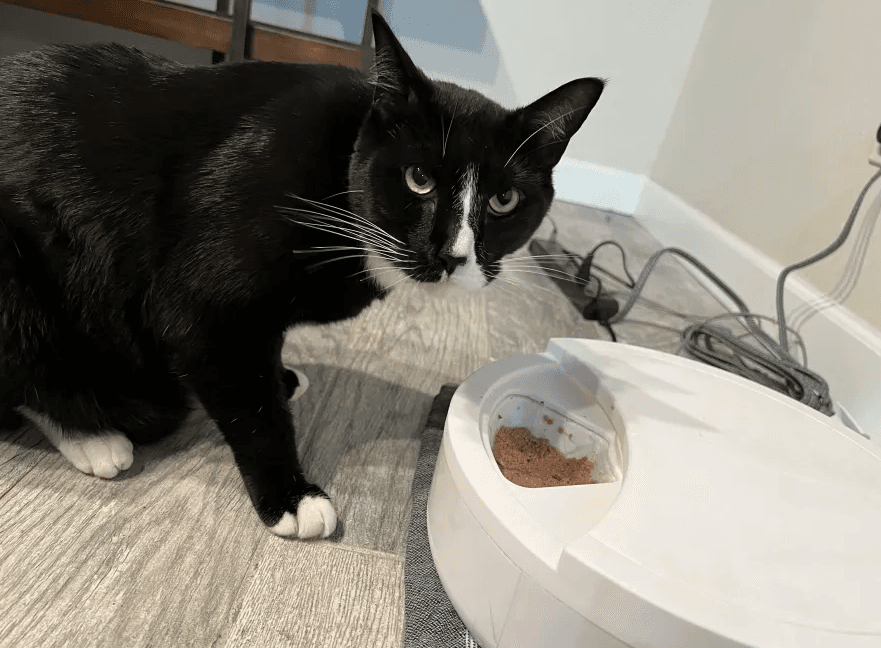
Three feeder concepts, with one standout. The standout was a wet-food feeder that solved the spoilage problem at its root. Most automated wet-food feeders use a Peltier element to drop food temperature by 10 to 20 degrees, which buys hours, not days, of safe storage. This design used a small compressor-based refrigeration cycle to hold food below freezing in the hopper, then warm a single portion before serving. Below freezing meant the food kept for up to a week without rot or mold. Two adjacent products ran alongside: a smart dry-food feeder paired with a connected water fountain, and a more experimental wet-food dispenser that mixed dry kibble with water at serve.
- Wet-food feeder with compressor-based sub-zero hopper and per-portion warmup at serve
- Up to a week of safe wet-food storage with no rot or mold risk
- Smart dry-food feeder paired with a connected water fountain
- Experimental wet-food dispenser that mixed dry kibble with water at serve
Hard parts
Form factor on a cat. A 14 by 30 mm board is not a lot of real estate for a SoC, radios, a 9-axis sensor, biometric optics, a microphone, a buzzer and LED, plus battery and charge circuit. Every component had to earn its square millimeter. The constraint that pushed back hardest was recharge cadence: a small battery means frequent recharges, which fights the entire premise of a wearable a cat keeps on. The collar layout was driven by that two-sided balance from the first board revision.
Refrigeration in a feeder. A Peltier in a feeder is easy and cheap and bad. The right answer for week-long wet-food storage was a small compressor cycle, which carries its own design problems in a consumer device: noise, vibration, condensation management, and the mechanical and thermal partition between a sub-zero hopper and a warm serving zone two inches away. Designing that boundary, and the portion-extraction mechanism that bridges it, was the most mechanically interesting work in the program.
Biometrics on a moving cat. Heart rate and SpO2 sensing through fur, with the cat moving, was the part of the collar that did not work yet in initial prototypes. Motion artifacts, fur contact, and skin-coupling all stack up against optical sensors. The collar shipped data collection for the paths that did work (activity, location-context, audio) while the biometric path stayed in research.
At a glance
- Collar SoC
- nRF52 series
- Collar size
- 14 by 30 mm board
- Collar sensors
- 9-axis IMU plus magnetometer; microphone; heart rate; SpO2; skin temperature
- Collar I/O
- Buzzer, LED
- Location context
- Tracking beacons at food, water, and litter stations
- Wet-food feeder
- Compressor-based sub-zero hopper with per-portion warmup; up to a week of safe storage
- Dry-food feeder
- Smart feeder paired with a connected water fountain
- Experimental feeder
- Wet-food dispenser mixing dry kibble with water at serve
- Status
- Initial prototypes built and bench-tested
Outcome
The collar prototyped through on-cat data collection. The feeders moved through mechanical and refrigeration design. The small-form-factor sensor-fusion layout from the collar and the sub-zero hopper architecture from the feeder are patterns Groundplane carries forward into future wearable and perishable-food-storage work.