nanoRC: Desktop Excavator Electronics
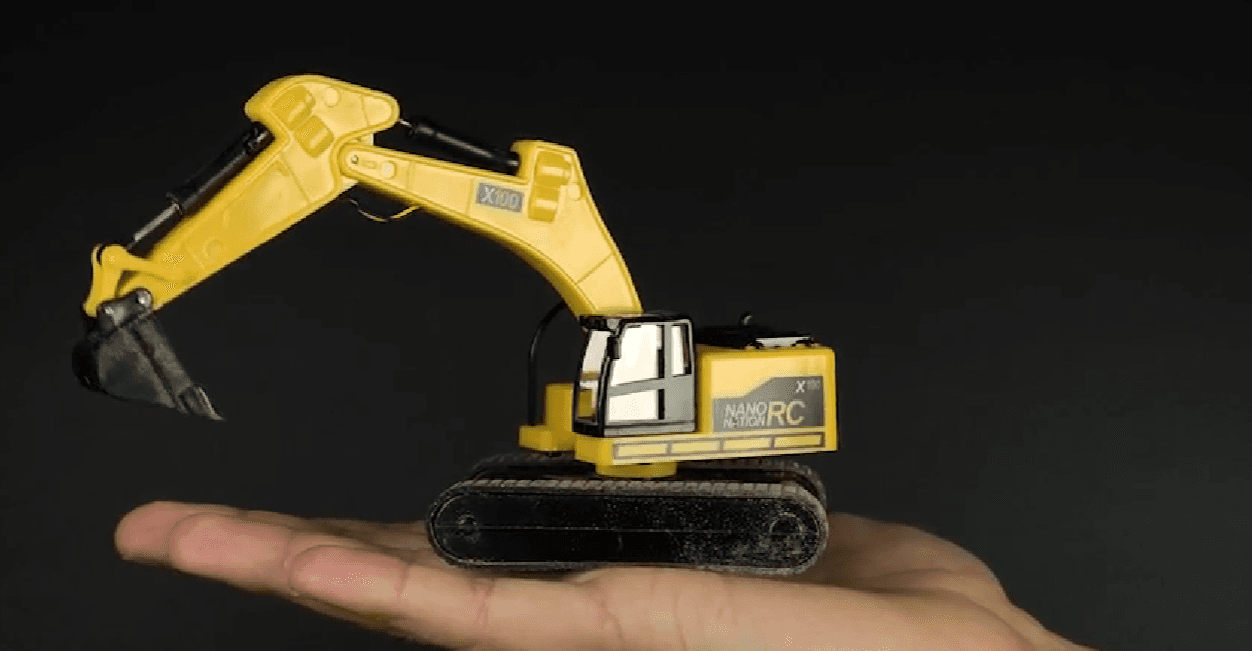
PCB design and firmware for nanoRC's NANO X100, a 1:64-scale fully-functional desktop excavator that raised over $350,000 on Kickstarter. We took over from a previous contractor, kept the existing board outlines for mechanical fit, and completely redesigned the controller and receiver electronics for longer battery life and dramatically lower BOM cost.
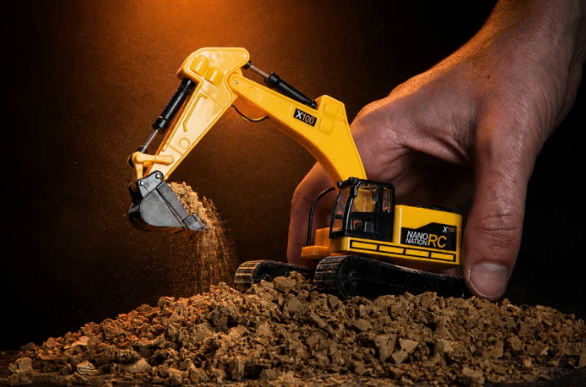
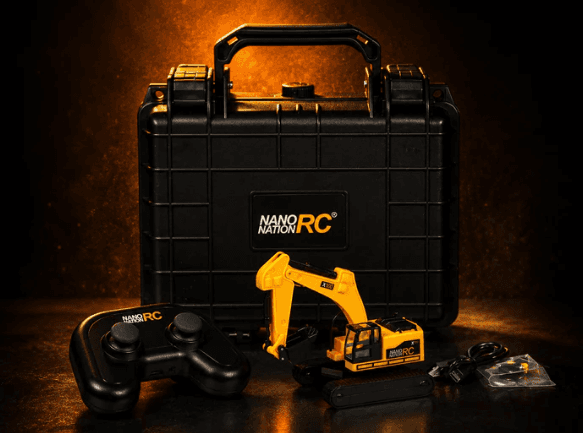
nanoRC came to us with a backed Kickstarter and stuck electronics. The NANO X100 is a 1:64-scale fully-functional desktop excavator: six independent proportional motors, a continuously-rotating slip-ring cab, independent skid-steer tracks, both ISO and SAE control schemes on the transmitter. Over 2,400 backers had pledged more than $350,000. The previous contractor's electronics work had hit a wall, so we were brought in to take over the in-vehicle receiver board and the transmitter controller board. The board outlines were already locked by the existing mechanical design, so we kept those and completely redesigned the electronics inside them, with two clear targets: extend battery life and cut BOM cost.
What we did
- Took over the in-vehicle receiver board and the transmitter controller board from the previous contractor
- Kept the existing board outlines to preserve mechanical fit; redesigned everything inside them from scratch
- Re-spec'd the BOM with cost in mind, saving the client tens of thousands of dollars on the initial production order
- Extended battery life to hours of motor-active runtime and days of standby
- Supported firmware development across both boards
- Designed and implemented pairing firmware so multiple transmitter and receiver units coexist cleanly
- Tuned the RF antennas in-system and supported the client through FCC certification testing
Hard parts
Same outline, different problem. The board perimeters were locked by the mechanical design backers were already expecting. We kept the outlines and rebuilt everything inside: power, motor drive, RF, MCU, IO. The constraint was useful, actually. It forced the redesign to optimize for the things the previous design didn't, rather than re-litigating choices that were fine.
Battery life on six motors. Six independent proportional motors plus a slip-ring cab is a lot of mechanical work for a desktop-scale device on desktop-scale batteries. Hours of motor-active runtime meant rethinking the power architecture (rail topology, regulator choices, sleep strategy), the motor-drive efficiency (driver selection, switching frequency), and the firmware (motor disable on idle, MCU sleep between control updates, RF duty cycle). The result: hours of run time with motors active, days of standby.
BOM at Kickstarter volume. The previous BOM carried parts that did not earn their cost at the production quantities needed for the first run. We re-spec'd the silicon, the connectors, the passives, and the supporting circuitry. Net savings: tens of thousands of dollars on the initial production order, material the client could put back into the rest of the product.
Antennas and FCC. The redesigned boards needed RF performance good enough for clean range and emissions clean enough to pass FCC. Antenna tuning happened in-system, where placement, ground plane, and the surrounding mechanical structure all push on the matching network. We tuned the antennas in their final mechanical context and supported the client through FCC certification testing to get the product ready to ship.
At a glance
- Product
- NANO X100, 1:64-scale fully-functional desktop excavator
- Scope
- In-vehicle receiver board, transmitter controller board, firmware support, pairing firmware, antenna tuning, FCC certification support
- Motors
- 6 independent proportional channels
- Mechanical
- Continuously-rotating slip-ring cab; independent skid-steer tracks
- Control
- ISO and SAE control schemes on the transmitter
- Battery life
- Hours of motor-active runtime; days of standby
- BOM impact
- Tens of thousands saved on the initial production order vs. previous design
- Status
- Delivered to client; product in production
Outcome
Two boards and the firmware delivered, both fully validated against the existing mechanical and motor stack. The pairing firmware also opens room for multi-unit play across future product variants. nanoRC continued through to manufacturing and fulfillment from there. More at nanorc.com.